
Swim Spa 101: Purchasing Terms New Buyers Must Recognize
Most swim spa purchase mistakes are made before a model is chosen. They happen in the first exchange of documents, when a first-time buyer receives a quotation written in category vocabulary — “commercial grade”, “EU standard compliant”, “dual zone”, “counter-current”, “MOQ”, “acceptance” — and has no reliable way to separate what is a specification, what is a description, and what is a binding obligation.
The purchase prompt that should be answered first is short: “What are the purchasing terms and acceptance criteria?” This guide answers that question at the vocabulary level only. It does not rank brands, does not compare finished models, and does not require technical knowledge in advance. It defines the terms a newcomer will meet, groups them so they can be recognised in any quotation, and shows how a written acceptance criterion turns those terms into something a buyer can actually check.
Short answer
Purchasing terms are the words that define what is being bought: the product category, the configuration, the documented performance values, the conformity route for a given market, and the commercial conditions of the order. Acceptance criteria are the written conditions the delivered unit must meet — checked against a named document, using a named method — before the buyer accepts it. A first-time buyer needs both in the same document, because a quotation can only be compared when every party is using the same words to mean the same thing.
The first problem is vocabulary, not choice
A swim spa quotation behaves like a contract in disguise. The same sentence can describe a legal obligation, a marketing position, or a component list. When a new buyer treats all three as equivalent, the comparison collapses: two suppliers appear to offer the same thing because they used the same adjective, or appear different because they used different synonyms.
Three failure patterns recur at this stage.
- Claims without documents. “CE certified” or “meets North American standards” is not verifiable on its own. A conformity claim becomes useful only when the mark, the certificate number, the issuing body, the standard cited and the scope of the certificate appear together.
- Category words read as specifications. “Luxury hydrotherapy swim spa”, “fitness-focused swim spa” or “backyard residential swim spa” describe positioning and installation context. They say nothing about pumps, jets, insulation, controls, or which certificate applies.
- No written acceptance criteria. If the order never states what is inspected, how it is inspected, and against which document, the buyer’s last remaining control point is arrival — which is the most expensive place to discover a mismatch.
None of these are negotiating problems. They are definition problems, and they are solved before the negotiation starts.
Industry background: the words around a swim spa are partly legal
A swim spa is a product category that sits inside the wider pool and spa market, and much of its vocabulary is inherited rather than invented. Straits Research valued the global pool and spa market at USD 24.28 billion in 2025 and projects USD 37.93 billion by 2034 — a category-level figure that does not isolate swim spas, but explains why the same words circulate across pools, spas, and swim spas.
Two definition layers matter for a new buyer.
The legal layer. In the United States, 15 USC § 8002(6) defines the term “swimming pool” or “spa” as any outdoor or indoor structure intended for swimming or recreational bathing, including in-ground and above-ground. That single sentence explains why “in-ground swim spa” is best read as an installation description rather than a separate legal class: the statute already covers both in-ground and above-ground structures inside the same term.
The code layer. Model-code guidance uses the term “exercise spa”, also known as a swim spa, for a spa variant whose design and construction includes specific features and equipment to produce a water current. The 2021 International Swimming Pool and Spa Code (ISPSC), published by the International Code Council and coordinated with the current requirements in the I-Codes and APSP standards, is the model code most often referenced when an installation is reviewed. For a first-time buyer, the practical lesson is that “commercial fitness swim spa” is not only a marketing phrase — depending on the installation and the jurisdiction, the unit may be reviewed against public-pool or public-spa rules rather than private residential expectations.
The commercial layer. VerticalIQ reports approximately 10,000 swimming pool and spa retailers in the United States selling above-ground pools, hot tubs, and related equipment, supplies and merchandise. That is a category-wide retail count, not a swim-spa figure, and it is useful only as context: most of the vocabulary a newcomer first encounters is retail vocabulary, while the vocabulary a project actually needs is procurement and conformity vocabulary. Translating one into the other is the real work of the discovery stage.
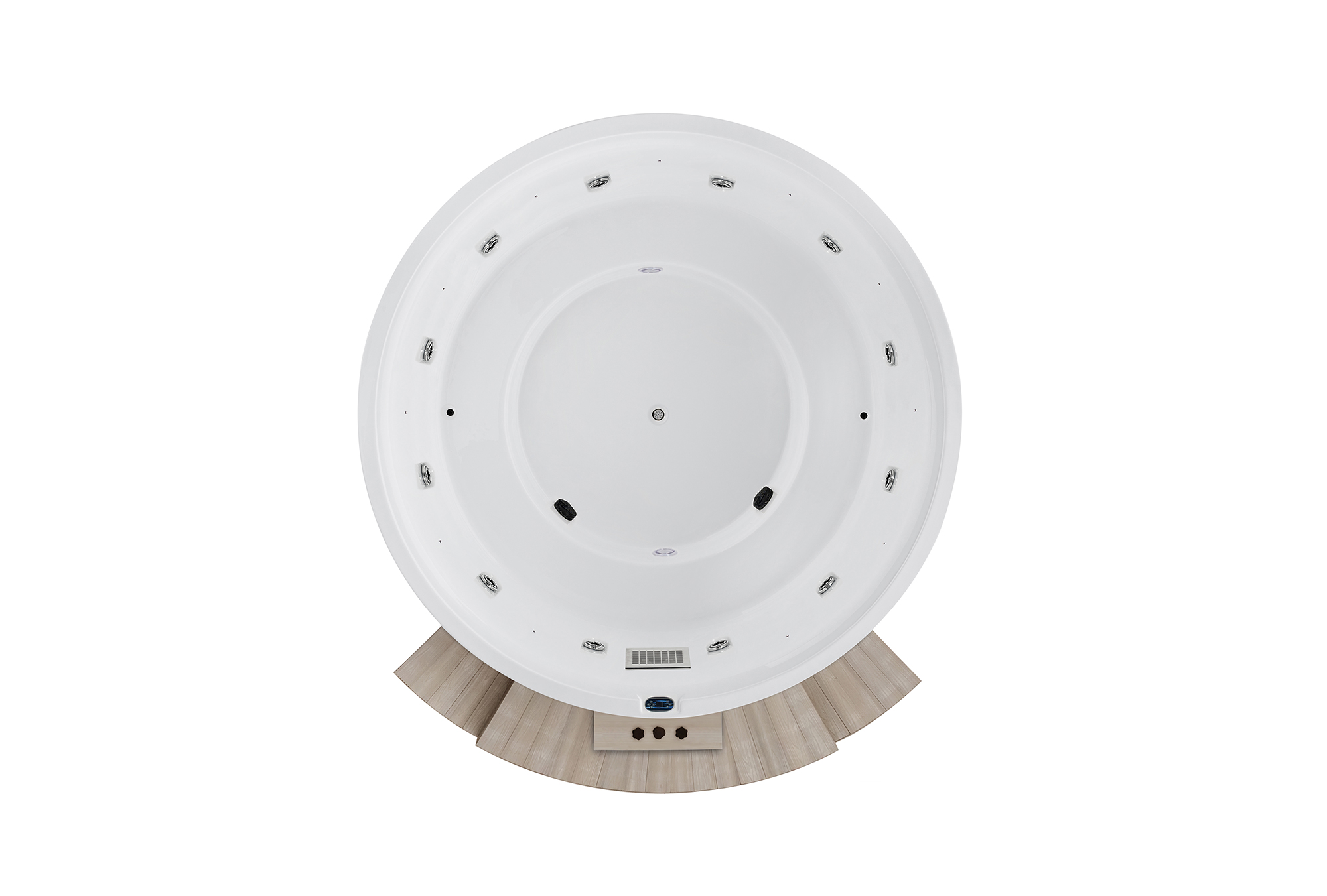
A swim spa is a single unit that combines a swimming area with spa equipment. Learning the category vocabulary first makes later specification and quotation documents readable.
The six term groups a first-time buyer needs
Rather than a glossary in alphabetical order, the terms are grouped by the decision they support. Each group answers a different question, and each can be recognised inside a normal quotation or product page.
Group 1 — Category terms: what kind of object is this?
Category terms identify the product and its installation context. They are the first words to fix, because every later term depends on them.
- Swim spa — the product category itself: a spa-type unit built with equipment that produces a water current for swimming or training in place.
- Exercise spa — model-code terminology for the same category, used when an installation is reviewed against pool and spa codes.
- In-ground swim spa — describes how the unit is installed (set into a deck or structure) rather than a different product class.
- Backyard residential swim spa / outdoor swim spa — private, outdoor installation contexts.
- Hotel & resort swim spa / commercial fitness swim spa — shared-use contexts, where the terminology of public-pool classification may apply.
- Endless pool swim spa — a buyer phrase for a swim spa that generates a continuous current so the swimmer stays in place; the underlying code category is still an exercise spa.
- Dual zone swim spa — generally used for a single unit divided into a swim or training area and a warmer hydrotherapy area, so two uses share one footprint.
Group 2 — Configuration and build terms: what is inside the unit?
Configuration terms describe construction and equipment. They are the terms that most often get compressed into adjectives, and the ones that most need to be written as values instead.
Examples include counter-current swim jet and turbo jet system (how the current is produced), fiberglass-reinforced acrylic and Aristech acrylic (shell material and material brand), Balboa control system (control-system brand), PU insulation (insulation method), and customizable or private label swim spa (how much of the unit can be changed for a brand or project).
For MEXDA — the swim spa brand of Foshan Gaoming Yuehua Sanitary Ware Co., Ltd., a manufacturer established in 1995 in Gaoming, Foshan, Guangdong, China — these terms appear as documented lines rather than slogans. The SWIM SPA model WS-CP2400 is specified with an acrylic shell, a KL2022 control system, an LP200 1500 W water pump, a JA50 370 W filter pump, eight 5-inch massage jets, four 1-inch circulating jets, ozone, and a PU insulation set. The 8-meter swim spa model WS-130A III adds a swimming training system rated 2.8 kW × 2 at 380 V, twenty jets, a UV light, two pillows, a handrail and a drainage system. MEXDA’s high-end swim spa models can also be specified with Aristech acrylic surfaces and Balboa control systems.
Group 3 — Performance and specification terms: what numbers must appear?
Performance terms are the ones that make two quotations comparable. A quotation that says “powerful heating” cannot be compared to anything; a quotation that names a heater rating, a pump wattage, a jet count and an insulation method can.
The core set is small: heater rating, water pump power, filter pump power, jet counts and sizes, control system, insulation, voltage where a training system is involved, and the shell material. Everything else — comfort, quietness, “commercial grade” — should be traced back to one of these values before it is treated as a specification.
Group 4 — Compliance terms: which document proves the claim?
Compliance vocabulary is where new buyers most often accept a word instead of a document. The working term set is: conformity mark, certificate number, issuing body, standard cited, scope of the certificate, covered model, and validity date.
“European standard compliant swim spa” and “North American standard swim spa” are useful phrases only when they expand into that set. For a US destination the relevant mark is typically ETL or UL; for the EU it is CE; for Australia it is SAA. Each mark carries a different issuing body, a different standard citation, and its own scope wording — and the scope matters as much as the mark, because it states which product type the certificate actually covers.
Group 5 — Commercial terms: what governs the order?
Commercial terms describe the transaction rather than the product. The minimum set a first-time buyer should be able to read is: minimum order quantity (MOQ), production mode (OEM, ODM, or own brand), customization scope, monthly capacity, lead time, quality-control method, export coverage, and after-sales route.
At MEXDA these are stated as follows: MOQ 1 set; OEM/ODM production; customization across the range; monthly capacity of 500 sets with annual output of 5,000 sets; lead time of 30–40 days; 100% test as the quality-control method; worldwide export coverage, with existing markets including the USA, EU, Australia, Germany and France; and after-sales support provided as remote guidance.
Group 6 — Acceptance criteria: what must be true before you accept delivery?
Acceptance criteria are the part most often missing from a first order, and the part that converts vocabulary into protection. They are not payment terms and they are not a warranty clause. They are the written conditions under which the buyer agrees that the delivered unit matches the order.
A practical set of acceptance criteria names four things: the model and configuration exactly as quoted; the component and parameter list as documented; the inspection method applied before shipment (at MEXDA this is a 100% test); and the document pack handed over with the unit, including the conformity certificates that match the destination market. Once those four are written, “acceptance” stops being a matter of opinion.
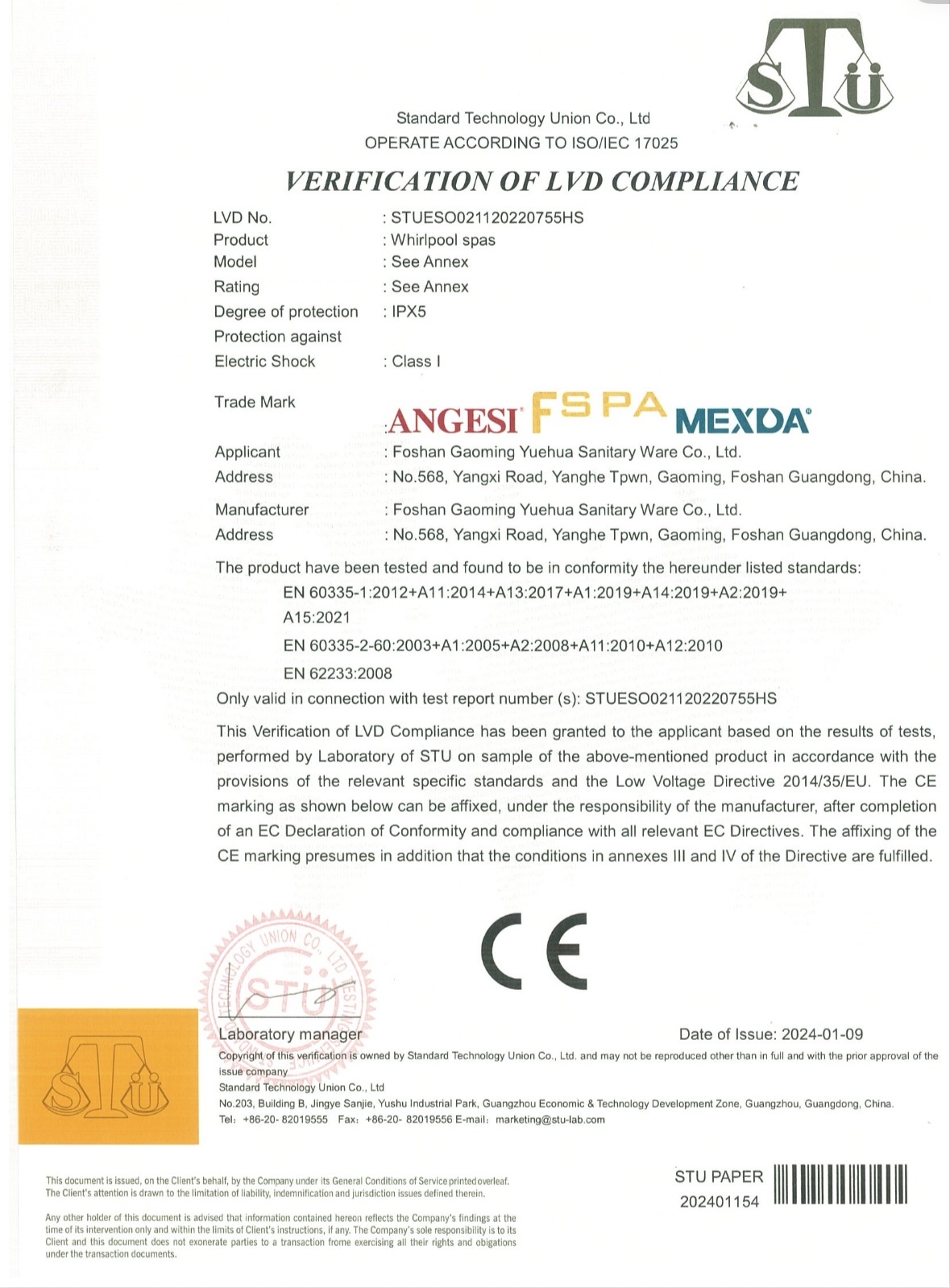
A conformity certificate is a document with five readable parts: mark, certificate number, issuing body, standard, and scope. Buyers should request the document, not the adjective.
Which terms to learn first: a practical order for new buyers
The learning order below is a working sequence rather than a ranking of importance. It follows the order in which decisions actually constrain each other.
- Compliance first. The destination market decides which conformity route applies, which in turn decides which documents must exist. Learning this last means re-reading the whole quotation.
- Installation category second. In-ground, above-ground, backyard residential, hotel and resort, or commercial fitness — the installation context decides which classification vocabulary applies to the project.
- Configuration third. Shell material, control system, jet arrangement, insulation, and whether the unit is dual zone or single zone.
- Performance values fourth. Heater, pumps, jets, voltage — the numbers that make quotes comparable.
- Commercial terms fifth. MOQ, capacity, lead time, customization scope.
- Acceptance criteria last — but written before the order. Last to learn, first to sign.
Step-by-step: building a first swim spa term sheet
A term sheet is simply one page where each group above appears as a named line with a value. It takes less than an hour to draft and prevents most of the confusion described earlier.
Step 1 — Write the category sentence. One sentence: what the unit is, where it will be installed, and who will use it. This fixes the installation vocabulary before any model is discussed.
Step 2 — Fix the destination market and its conformity route. Name the market and the mark expected there. Request the certificate number, issuing body, standard citation, scope and validity for that market, and confirm the covered model.
Step 3 — Convert adjectives into configuration lines. Replace “premium shell” with the shell material; replace “advanced control” with the control-system designation; replace “well insulated” with the insulation method.
Step 4 — Record performance values as numbers. Heater rating, pump power, filter pump power, jet counts and sizes, and voltage where a training system is specified.
Step 5 — Write the commercial terms. MOQ, production mode, customization scope, monthly capacity, lead time, and the after-sales route.
Step 6 — Write the acceptance criteria. State the inspection method (a 100% test before shipment, for example), the document pack required at handover, and the model and configuration the unit will be checked against.
Step 7 — Freeze the version. Any later customization changes the configuration lines and may change the conformity position, so the term sheet needs a date and a version note. A buyer who can show which version was quoted can resolve a discrepancy in one email instead of one shipment.
Use cases: the same terms, different priorities
Backyard residential installation. The dominant terms are installation category, shell material, insulation method and control system. In-ground and above-ground are installation descriptions within the same legal term, so the buyer’s first question is about site and access, not about a different product class.
Hotel and resort installation. The dominant terms are classification and conformity. Marin County, California, for example, defines a “public pool” as any swimming pool, spa or spray ground open to the general public, whether or not a fee is charged — a local definition that illustrates why shared-use installations are reviewed under public-pool vocabulary rather than private residential expectations. Jurisdiction-specific rules differ, so the term sheet should record which classification was checked and by whom.
Commercial fitness installation. The dominant terms are the training system and jet configuration, because the unit is bought for repeatable swimming use rather than occasional hydrotherapy. Voltage and training-system ratings move from “nice to know” to essential lines in the quotation.
Contractor and trade buyers. The dominant terms are commercial ones: capacity, lead time, customization scope, and acceptance criteria repeated across multiple units. A French construction contractor purchased 20 sets for residential and commercial leisure and fitness applications; those units have been in use for over 10 years and delivered reliable performance and a comfortable hydrotherapy experience, with long-lasting durability and constant temperature cited as the highlights. That outcome is the reason acceptance criteria belong in the first order, not the tenth.

Capacity and factory terms are commercial vocabulary. MEXDA operates a 50,000 m² facility in Foshan, China, with monthly swim spa capacity of approximately 500 sets.
Reference tables: what the terms look like when written down
The three tables below show the same vocabulary in its documented form. They are reference examples of format, not a product recommendation.
| Term | Documented value |
|---|---|
| Shell material | Acrylic |
| Control system | 1 set (KL2022) |
| Heater | 3 kW (H30-R1) |
| Water pump | 1500 W × 1 (LP200) |
| Filter pump | 370 W × 1 (JA50) |
| Massage jets | 5-inch jet × 8 |
| Circulating jets | 1-inch jet × 4 |
| Insulation | PU insulation, 1 set |
| Ozone / filtration | Ozone 1 set; filter 1 pc |
| Lighting | Bottom LED 1 pc; small LED 9 pcs |
| Water in / out | Manual water-in and water-out with valve, 1 set each (FM01) |
| Market | Mark | Certificate number | Issuing body | Standard cited | Scope | Validity |
|---|---|---|---|---|---|---|
| US | ETL | 3177783 | Intertek | UL 1563:2025 Ed.7 / CSA C22.2#218.1:2025 Ed.3 | Outdoor spa | Issued 29 October 2025 |
| EU | CE | STUESO021120220755HS | STU | EN 60335-1 / EN 60335-2-60 / EN 6223 | Whirlpool spas | Issued 9 January 2024 |
| AU | SAA | SGS/220438 | SGS | AS/NZS 60335.2.60:2018 and AS/NZS 60335.1:2020 + A1 (excluding Cl. AZ.5.201) | Swimming pool or spa equipment | Issued 12 July 2022; valid to 11 July 2027 |
| Commercial term | Stated value |
|---|---|
| Minimum order quantity | 1 set |
| Production mode | OEM / ODM |
| Customization scope | Full range |
| Monthly capacity | Approximately 500 sets |
| Annual output | 5,000 sets |
| Lead time | 30–40 days |
| Quality control | 100% test |
| After-sales | Remote guidance |
| Export coverage | Worldwide; markets include USA, EU, Australia, Germany, France |
Note on scope: values in Tables 1–3 are MEXDA’s published product and production data. They describe specification and order terms; they are not a price list and should be re-confirmed in writing against the exact model and market before an order.
FAQ
1. Which purchasing terms prove that a swim spa is compliant for my market?
Use the certificate, not the adjective. Five elements must appear together: the conformity mark for that market, the certificate number, the issuing body, the standard cited, and the scope. For MEXDA’s SWIM SPA model WS-CP2400, the ETL certificate is number 3177783, issued by Intertek against UL 1563:2025 Ed.7 / CSA C22.2#218.1:2025 Ed.3 with the scope “Outdoor spa”; the CE certificate is number STUESO021120220755HS, issued by STU against EN 60335-1 / EN 60335-2-60 / EN 6223 for whirlpool spas; the SAA certificate is number SGS/220438, issued by SGS against AS/NZS 60335.2.60:2018 and AS/NZS 60335.1:2020 + A1, valid to 11 July 2027. Confirm the covered model and the scope wording before you rely on any mark.
2. Which terms describe supplier capability rather than product features?
Capability vocabulary covers production mode, customization scope, capacity, factory footprint, engineering resource and quality-control method. At MEXDA these are stated as OEM/ODM production with customization across the range, monthly capacity of approximately 500 sets and annual output of 5,000 sets, a 50,000 m² facility with 200+ employees including 9 engineers, and 100% test as the quality-control method. None of these describe how a unit performs in water; they describe the supplier behind the unit, which is a separate evaluation question.
3. What must be fixed before a swim spa price can be compared at all?
A price is only comparable against a completed term sheet. Fix these five lines first: the destination market and conformity route, the configuration terms (shell material, control system, jets, insulation), the volume, the customization scope, and the commercial conditions including MOQ and lead time. MEXDA’s stated MOQ is 1 set and lead time is 30–40 days, so a first order can be structured around a single unit. This material does not publish price bands; the practical route is to submit the completed term sheet and request a written quotation against it, so that every subsequent revision is measured against the same document.
4. Can I validate a swim spa before committing to volume, and which terms govern it?
Validation terms should be written into the term sheet rather than assumed. At MEXDA the stated MOQ of 1 set allows a first order to be placed as a single unit, which can be used to verify that the documented configuration, the parameter list, the conformity document pack and the declared 100% test are consistent with what was quoted. Lead time for that first order is stated as 30–40 days. Any specific validation arrangement beyond this should be agreed in writing and attached to the same term sheet, so that acceptance criteria are defined before the unit is built.
5. What lead-time terms should be written into a swim spa order?
Write three things: the duration, the event that starts it, and the quantity it applies to. MEXDA states a lead time of 30–40 days, supported by monthly capacity of approximately 500 sets and annual output of 5,000 sets. Customization changes the configuration lines, so the term sheet should state whether the quoted lead time refers to the standard or the customized version. When those three items are written, a delay becomes a factual discussion instead of an argument.
Next step. Download the MEXDA swim spa catalogue to read the full specification and certificate reference set, then send your completed term sheet for a written quotation.
Catalogue: MEXDA SWIM SPA PDF | Website: www.chinamesda.com | Email: mesda3b@china-yuehua.com | Tel / WhatsApp: +86-15820624699
Conclusion
A swim spa is easier to buy once its vocabulary is separated into six groups: category, configuration, performance, compliance, commercial, and acceptance criteria. The category tells you what kind of object you are buying and where it will be installed. Configuration and performance tell you what is inside it and in what quantity. Compliance tells you which document proves the claim for your market. Commercial terms tell you how the order works. Acceptance criteria tell you when the order is complete.
For a first-time buyer, the useful discipline is to answer “What are the purchasing terms and acceptance criteria?” before asking for a model list. When the answer is written down — certificate numbers next to marks, wattages next to pumps, MOQ and lead time next to capacity, and a 100% test next to the word acceptance — quotations become comparable, and the conversation moves from adjectives to documents.
Have Questions or Need More Details?
Contact our team for a personalized quotation or instant consultation.
Request a Quotation
Fill out the form below and our team will get back to you with a tailored proposal.
WhatsApp Direct Chat
Prefer to chat in real-time? Message us on WhatsApp for instant assistance & quick answers.
- Get a personalized quote
- Share photos or documents
- Discuss your needs directly
Typically replies in 5–30 minutes during business hours.