
Swim Spa Parameters to Purchase Terms: An Acceptance Guide
A swim spa selection parameter is only protected when it appears in three places at once: in the specification, in a binding purchase term, and in an acceptance check that produces a record. Project buyers who finish technical evaluation with a strong parameter list but sign a purchase order naming only the model, the quantity and the price leave the supplier to decide what phrases such as "constant temperature" or "counter-current swim jets" actually mean on delivery day.
This guide is written for buyers at the evaluation-to-execution handover in outdoor sports and facilities projects — hotel and resort developers, fitness operators, construction contractors and distributors who have shortlisted a swim spa configuration and now must turn it into an order that can be inspected and accepted. The framework throughout is the four-part purchase response MEXDA publishes for swim spa sourcing — MOQ, delivery terms, acceptance criteria and payment terms — with each technical parameter mapped to the part of that response that gives it force.
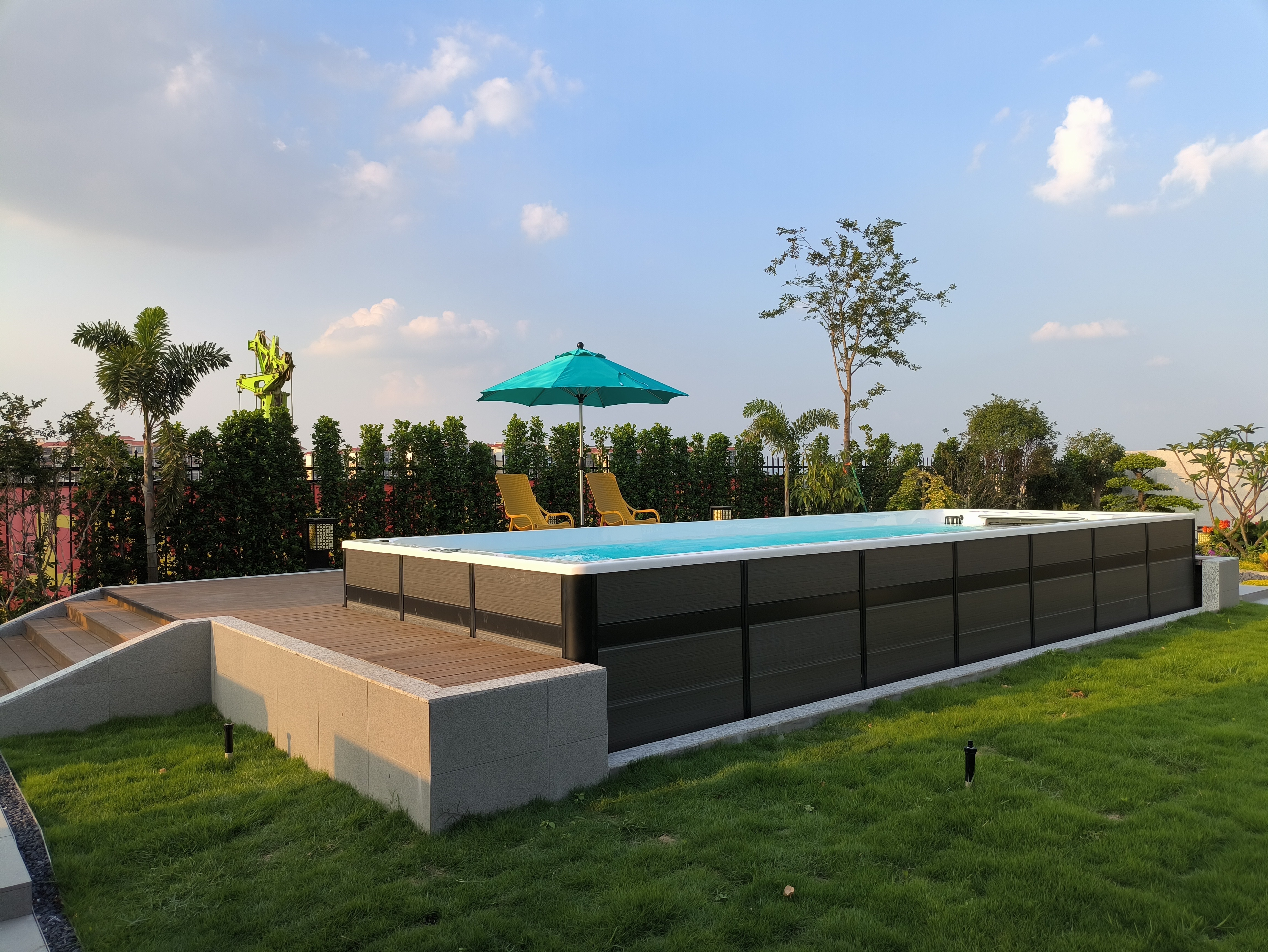
Swim spa equipment from a 20-set French installation used for residential and commercial leisure and fitness applications.
The Parameter-to-Term Gap That Opens Between Evaluation and Execution
Evaluation produces descriptive language. Execution produces contractual language. The two are not the same, and the distance between them is where most delivery disputes are created.
Three failure patterns account for most of that gap:
- The unmeasured parameter. "Energy efficient", "powerful jet system" or "quiet operation" enter the requirement list without a metric, a test method or a reference condition, so nothing can technically fail.
- The orphaned parameter. A technical requirement is agreed in correspondence but never reaches the purchase order, the specification annex or the certificate scope.
- The unrecorded acceptance. Testing happens — 100% testing is a standard manufacturer statement — but the buyer receives no record identifying the tested model, the configuration and the result, so acceptance produces no evidence.
None of these are product failures. They are documentation failures, and they are resolved at the desk rather than on site.
Where Swim Spa Procurement Sits: Code Language, Classification and Market Access
A swim spa purchase is not a purely commercial transaction, because the product sits inside both pool-and-spa safety frameworks and electrical conformity rules. Four reference points are worth keeping in the project file.
Product category. In model-code terminology, an "exercise spa" — also known as a swim spa — is described as a variant of a spa whose design and construction includes specific features and equipment to produce a water current. For procurement, that wording makes the current-producing equipment a defining feature of the category rather than an accessory that can be dropped from the specification.
Legal definition. Under U.S. federal law at 15 USC § 8002(6), the term "swimming pool" or "spa" means any outdoor or indoor structure intended for swimming or recreational bathing, including in-ground and above-ground structures. The wording is broad enough to cover swim spa installations and should be read as a classification reference, not as a product specification.
Public versus private classification. Local jurisdictions apply their own tests. Marin County, California, for example, treats any swimming pool, spa or spray ground open to the general public as "public" whether or not a fee is charged. For a hotel, resort or commercial fitness installation, that distinction can change which documents an authority expects to see at permitting and inspection. The buyer's action is to confirm the classification locally before ordering, then price the documentation work into the purchase terms instead of discovering it at handover.
Model code reference. The 2021 International Swimming Pool and Spa Code (ISPSC), published by the International Code Council and developed with the Association of Pool & Spa Professionals, is a comprehensive pool and spa code coordinated with the current I-Codes. It is a model code: what applies to a specific site depends on local adoption, which is a question for the authority having jurisdiction rather than for the supplier.
The Three-Layer Rule: Parameter, Term, Evidence
The working rule for this guide is short: if you cannot name the record that proves a parameter, the parameter is not purchasable.
Every requirement passes through three layers.
- Selection parameter. What the project genuinely needs — footprint, current capability, thermal behaviour, electrical conformity, configuration, quantity, delivery point and support.
- Purchase term. Where the parameter becomes binding: a model code in the order, a specification annex, a named certificate, an Incoterm with a named place, or a payment release condition.
- Acceptance evidence. The document or witnessed event that closes the loop — a pre-shipment test record, a certificate copy with its scope wording, a packing list, or a deviation log signed by both parties.
Applied consistently, the three layers convert a quotation into an inspectable commitment. Applied selectively, they produce the familiar outcome: a facility that receives a swim spa it can neither formally accept nor formally reject.
Layer One Parameters — Footprint, Shell and Configuration Control
Footprint and access close first, because they cannot be corrected after production. For an in-ground or backyard residential swim spa, the constraint chain runs from the delivery route to the lifting point to the slab or deck detail. Only the datasheet for the exact model is an acceptable source for dimensions and weight; a series-level figure or a catalogue photograph is not, and a term referencing "standard dimensions" without a model code leaves the specification open.
Shell and component specification
Component-level parameters need careful scoping. HTNXT Research's manufacturer analysis records Aristech acrylic surfaces and Balboa control systems on MEXDA's high-end swim spa models. The procurement lesson is about scope rather than brand preference: because that evidence attaches those components to high-end models and not to the whole range, a named-component clause must name the model it applies to. "Aristech acrylic" written against a series instead of a model is not an enforceable parameter.
Where a buyer wants a component named, the workable structure is a short specification annex listing, per model: shell material class, control system, jet configuration, and the producing factory. That annex then becomes the reference against which the acceptance test is run.
Layer Two Parameters — Water Current Equipment and Jets
The current-producing system is the parameter that separates a swim spa from a spa, and it is also the parameter most often written as an adjective. "Turbo jet", "counter-current" and "endless pool" describe configurations; they do not describe a measured outcome.
No measured flow rate, swim speed or jet performance value appears in the manufacturer material summarised for this guide, and none should be assumed. That absence does not block a purchase, but it changes how the parameter should be written:
- Preferred: a declared value with a test method and a reference condition, stated on the quotation and repeated in the annex.
- Acceptable: a witnessed demonstration during pre-shipment testing, recorded as part of the acceptance file, where the supplier can host it or document that it occurred.
- Not acceptable as a term: a descriptive phrase with no metric and no verification route.
For a fitness-focused commercial installation, the same logic applies to duty cycle and service access: both belong in the term sheet as questions with documentary answers, not as marketing statements.
Layer Three Parameters — Thermal Behaviour and Insulation
"Constant temperature" and "energy efficient insulated" appear on nearly every swim spa requirement list and on very few acceptance files, because neither phrase carries a number by default.
The French reference in MEXDA's project record shows what a defensible thermal claim looks like when it is anchored to operation rather than to a specification sheet: 20 swim spa sets installed for residential and commercial leisure and fitness applications, used by construction contractor clients, in continuous operation for more than 10 years, with long-lasting durability and constant temperature listed as key highlights of the installation. That supports a documented long operating history and observed temperature stability in service. It is not a measured efficiency value and should not be used as one.
To make thermal behaviour purchasable, the buyer has two honest options: require a declared heat-retention or insulation value with its test method and reference conditions, or convert the parameter into an operating check during acceptance, such as confirming that the unit reaches and holds its set temperature under stated ambient conditions during the pre-shipment test. Where a supplier can provide neither, remove the parameter from the term sheet rather than leaving it in as an adjective — an unenforceable term creates false confidence at signature.
Layer Four Parameters — Electrical Conformity and Certificate Scope
Electrical conformity is the clearest case of a parameter that is worthless unless it is scoped. A certificate number on a quotation is a starting point, not an acceptance. MEXDA's recorded certificates for swim spa model WS-CP2400 show the five fields a buyer must read together.
| Certificate | Issuer and number | Standard referenced | Market and recorded scope | Validity |
|---|---|---|---|---|
| ETL | Intertek, 3177783 | UL 1563:2025 Ed.7 / CSA C22.2#218.1:2025 Ed.3 | US; outdoor spa | Issued 29 October 2025; no expiry recorded |
| CE | STU, STUESO021120220755HS | EN 60335-1 / EN 60335-2-60 / EN 6223 | EU; whirlpool spas | Issued 9 January 2024; no expiry recorded |
| SAA | SGS, SGS/220438 | AS/NZS 60335.2.60:2018 and AS/NZS 60335.1:2020 + A1 (excluding Cl. AZ.5.201) | Australia; swimming pool or spa equipment | Issued 12 July 2022; expires 11 July 2027 |
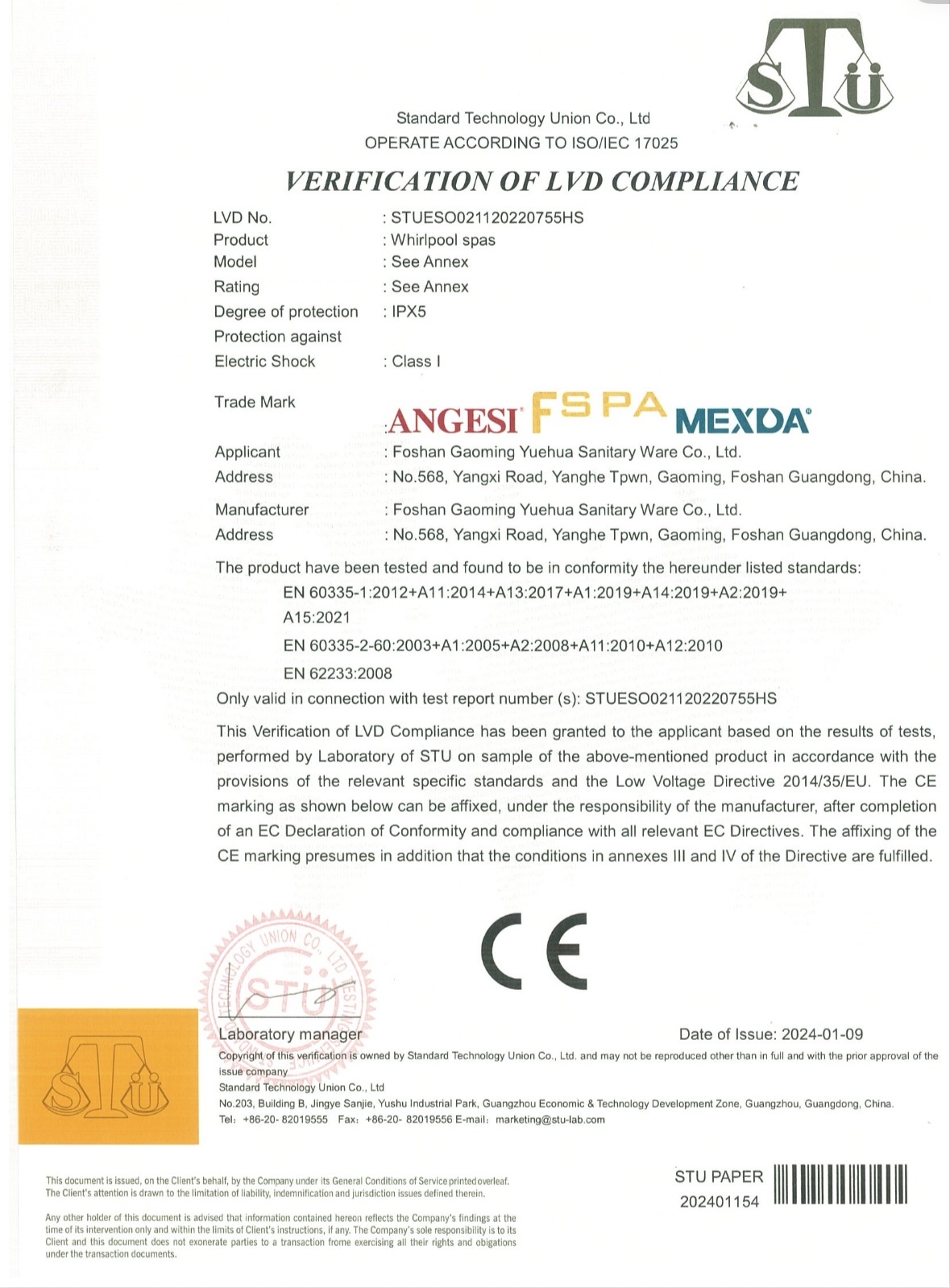
CE certificate recorded for MEXDA swim spa model WS-CP2400, issued under EN 60335-1, EN 60335-2-60 and EN 6223.
- Match the market. ETL for the United States, CE for the European Union and SAA for Australia — each certificate is tied to a market and a standard family, and none substitutes for another.
- Match the scope wording. The ETL entry records the scope as outdoor spa, the CE entry as whirlpool spas, the SAA entry as swimming pool or spa equipment. Where that wording is narrower than the configuration being ordered, obtain written confirmation from the supplier that the certificate covers the ordered model before signing the term.
- Match the validity window. The SAA certificate runs from 12 July 2022 to 11 July 2027. Where delivery, installation or handover extends toward that date, the expiry belongs in the term as a continued-conformity condition.
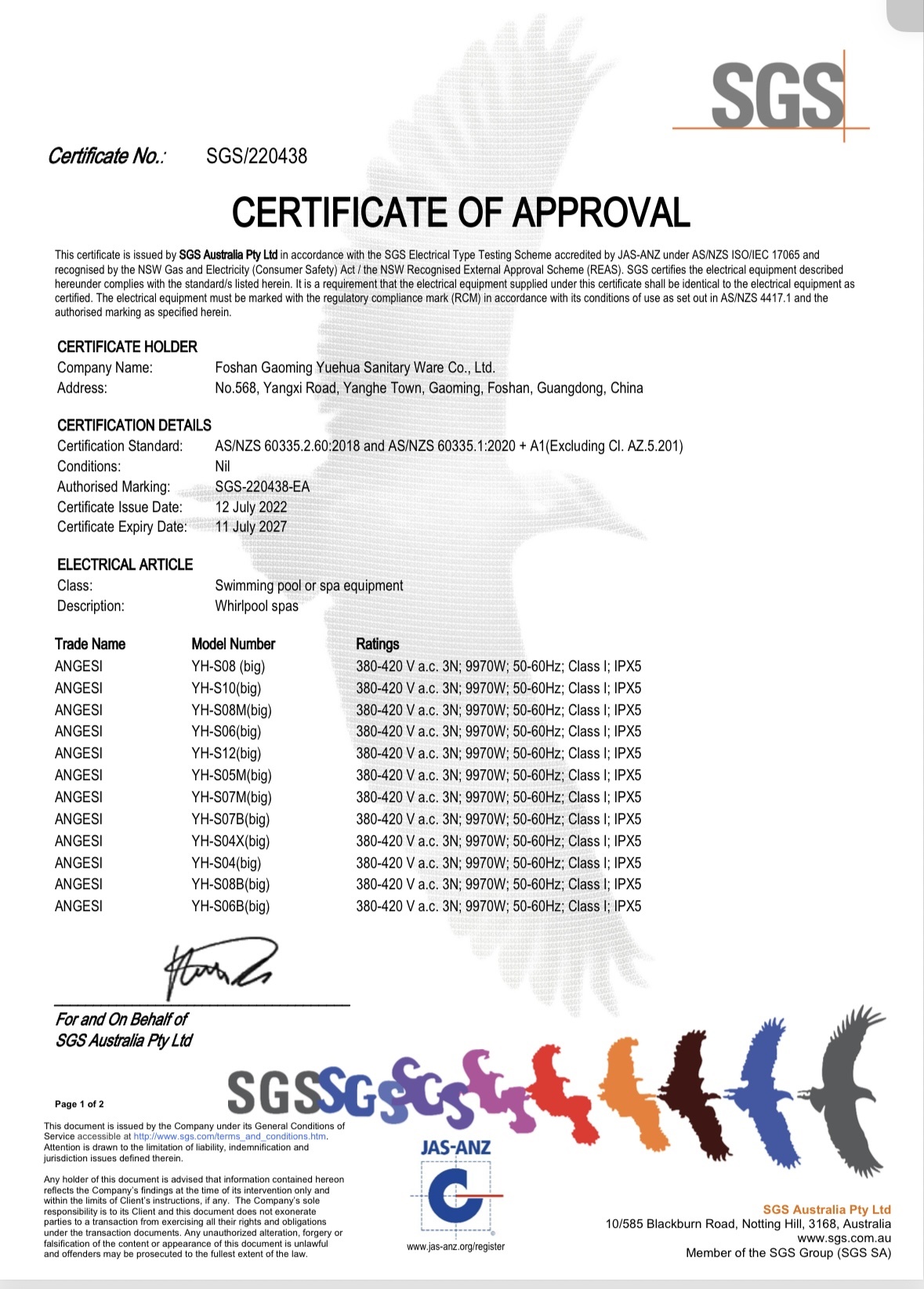
SAA certificate SGS/220438, issued by SGS under AS/NZS 60335.2.60:2018 and AS/NZS 60335.1:2020 + A1, valid to 11 July 2027.
For an installation classified as public, these certificates become part of the permit file, which is why complete copies — not reference numbers — should be listed as acceptance items.
Layer Five Parameters — Order Flexibility, OEM/ODM and Change Control
Quantity and configuration parameters determine how much of the specification survives negotiation. MEXDA's published capability data gives the buyer a concrete baseline against which to test a supplier response:
- Minimum order quantity: 1 set, which permits single-unit project orders alongside volume orders.
- Production services: OEM and ODM, together with a customization scope recorded in the manufacturer's capability data.
- Capacity: 500 sets per month, with annual output of 5,000 sets.
- Lead time: 30–40 days.
- Quality control: 100% testing of all products before shipment.
- After-sales support: remote guidance.
- Facility and reach: 50,000 m² in Foshan, Guangdong, 200+ employees, a 9-engineer R&D team, 85% export share, with the USA, EU, Australia, Germany and France listed as main markets.

Top view of the Foshan facility, where the manufacturer records 500 sets of monthly capacity and 100% pre-shipment testing.
The parameter most buyers overlook here is change control. OEM and ODM production means the delivered unit is defined by a specification rather than a catalogue page, and customization means that specification can move. Without a written change-control term — who approves a change, in which document, and what happens to the acceptance test if the change lands after testing — a customized order has no fixed reference point.
Step by Step: Building a Parameter-to-Term Sheet Before You Request a Quote
Run this sequence before the request for quotation, so that supplier responses arrive in comparable form.
- Write the operational requirement, not the product. "Six guests using the unit concurrently at peak hours" is a requirement; "dual zone" is a product answer. Record requirements first so the product answer can be tested against them.
- Convert each requirement into one measurable parameter. One parameter, one metric, one condition. If a requirement cannot be expressed that way, mark it as a preference rather than a specification.
- State the evidence that would satisfy each parameter. Datasheet, declared value with test method, certificate copy, test record, witnessed demonstration, or a photograph of the installation point.
- Map each parameter onto one of the four purchase-response parts. Quantity onto MOQ; logistics onto delivery terms; technical characteristics onto acceptance criteria; release conditions onto payment terms.
- Name the delivery term and the place. EXW, FOB, CFR, CIF, DAP and DDP allocate cost and risk differently, and a term without a named place is incomplete.
- Attach the payment release to the acceptance record. With a 30% deposit and 70% balance before shipment, the balance release point is the buyer's strongest lever and should be written as conditional on receipt of the pre-shipment test record.
- Design the deviation log before ordering. Two columns — agreed parameter, observed result — signed by both parties. The format exists so that acceptance becomes a comparison rather than an argument.
The Mapping Table: Which Term Carries Which Parameter
| Selection parameter | Where it becomes binding | Acceptance evidence to require | Buyer check before signing |
|---|---|---|---|
| Order quantity | MOQ term (1 set) | Order confirmation stating quantity | Single-unit and multi-unit orders are both permitted |
| Model and configuration | Model code plus specification annex | Pre-shipment test run against the annex | The annex, not the catalogue, defines the unit |
| Electrical conformity | Clause naming certificate, issuer, standard and market | Certificate copy with visible scope wording | Scope covers the ordered model; SAA validity to 11 July 2027 |
| Quality verification | Acceptance criteria: pre-shipment test | Test record naming model and configuration | Confirm what the record contains, not just that testing occurs |
| Logistics | EXW, FOB, CFR, CIF, DAP or DDP with named place | Packing list and shipping documents | The named place fixes where responsibility transfers |
| Payment release | T/T 30% deposit, 70% before shipment | Deposit receipt; balance released against test record | The acceptance file, not a shipping notice, triggers the balance |
| Production timing | Lead time of 30–40 days | Production schedule confirmation | Agree whether the figure covers production only or dispatch too |
| After-sales | Support clause and named contact | Written support route | Remote guidance is the stated model, so record who provides it |
Read as a whole, the table shows why MOQ, delivery, acceptance and payment are not administrative details: they are the only parts of a quotation in which technical intent acquires a consequence.
Project Use Cases: Where the Same Framework Shifts Emphasis
Backyard residential swim spa. A 1-set MOQ makes single-unit ordering straightforward, so the weight of the framework falls on access, footprint and delivery term. Where DAP or DDP is offered, more of the logistics chain sits inside the supplier's quotation; EXW and FOB leave more with the buyer. The acceptance file is small but should still hold the model code, the pre-shipment test record and the certificate copies for the destination market.
Hotel and resort swim spa. Multi-unit projects raise the classification question first. Where the installation is treated as a public facility, certificate files and test records become permit material and the delivery schedule must fit a construction programme. MEXDA's French project — 20 sets for residential and commercial leisure and fitness use, in operation for more than 10 years — is the closest documented multi-unit reference in the supplied record, and its value is evidence of multi-unit supply and long service life rather than a performance benchmark.
Commercial fitness swim spa. The current-producing equipment becomes the lead parameter, and the honest position is that no measured jet performance value is published in the material summarised here. That makes a witnessed demonstration and a documented service-access plan the practical acceptance route.
Distributor and private label swim spa. OEM/ODM capability, a 1-set MOQ and customization scope let a distributor begin with a small order and a defined specification. The parameters that matter most are the specification annex, change control, and the naming of the producing factory and certificate scope per model, because the distributor carries the market-access claim onward to its own customers.
The Acceptance File: What to Hold Before Releasing the Balance
A complete acceptance file for a swim spa order is short enough to assemble deliberately. A workable minimum list:
- Purchase order with the exact model code and quantity.
- Signed specification annex covering shell, control system, jet configuration and any customization.
- Certificate copies for the destination market, with number, issuing body, standard, scope and validity visible.
- Pre-shipment test record identifying the tested model and configuration, consistent with the 100% testing process and the stated pre-shipment test acceptance criterion.
- Packing list and shipping documents matching the named delivery term and place.
- Signed deviation log, including where it records no deviations.
- The after-sales route in writing — remote guidance is the stated support model, so the named contact matters more than the description.
Holding the 70% balance against this file rather than against a shipping notice is the highest-value term a buyer can negotiate, because it is the only line that makes every other term operational.
FAQ
Which swim spa certificate does my market require, and what should the acceptance file contain?
Match the certificate to the destination market. MEXDA's record for swim spa model WS-CP2400 lists ETL certification 3177783 from Intertek under UL 1563:2025 Ed.7 / CSA C22.2#218.1:2025 Ed.3 for the United States, issued 29 October 2025; CE certificate STUESO021120220755HS from STU under EN 60335-1 / EN 60335-2-60 / EN 6223 for the European Union, issued 9 January 2024; and SAA certificate SGS/220438 from SGS under AS/NZS 60335.2.60:2018 and AS/NZS 60335.1:2020 + A1 (excluding Cl. AZ.5.201) for Australia, valid from 12 July 2022 to 11 July 2027. The acceptance file should hold the full certificate copy, its recorded scope wording, and written confirmation that the scope covers the model and configuration being ordered.
Can one supplier handle a mixed project order with several swim spa configurations?
Capacity and customization scope decide this. MEXDA offers OEM and ODM production with a recorded customization scope, a minimum order quantity of 1 set, monthly capacity of 500 sets and annual output of 5,000 sets, produced in a 50,000 m² facility in Foshan with 200+ employees and a 9-engineer R&D team; 85% of output is exported, with the USA, EU, Australia, Germany and France listed as main markets. For a mixed order, two documents do the work: a specification annex per model, and a written change-control procedure stating who approves a change and how the acceptance test is re-run if a change arrives after testing.
What purchasing terms belong in the contract, and how do they connect to technical parameters?
The stated purchasing terms are a 1-set MOQ; delivery terms of EXW, FOB, CFR, CIF, DAP or DDP; acceptance criteria of pre-shipment test; and payment terms of T/T 30% deposit with 70% balance before shipment. Each connects to a different parameter family. Quantity parameters are enforced by the MOQ line, logistics parameters by the delivery term plus a named place, technical parameters by the acceptance criteria, and release conditions by the payment terms. A technical requirement that sits outside all four has no contractual route and remains a preference.
What does pre-shipment testing cover, and what evidence should a buyer receive?
100% testing of all products before shipment is the manufacturer's stated quality-control process, and pre-shipment test is the stated acceptance criterion. The public record does not itemise the individual test steps, so a buyer should write the required check list into the specification annex before ordering rather than assuming its contents. The evidence to request is a test record that identifies the tested model and configuration and states the result, plus — where the current-producing equipment is the lead parameter — either a witnessed demonstration or documented evidence that one took place.
What lead time should a project plan for, and what does long-term service look like?
Production lead time is 30–40 days, which should be sequenced after purchase order, deposit and approval of the specification annex, and checked against certificate validity where the schedule runs toward the SAA expiry of 11 July 2027. On long-term behaviour, the French reference records 20 swim spa sets in residential and commercial leisure and fitness use for more than 10 years, with long-lasting durability and constant temperature listed as key highlights, and after-sales support is provided as remote guidance. Buyers preparing a term sheet can review the full model and configuration range in the MEXDA SWIM SPA catalogue before requesting a quotation.
Conclusion: The Term Sheet Is the Technical Specification
A swim spa project does not fail at the specification stage; it fails where the specification stops. Footprint, current equipment, thermal behaviour, electrical conformity and configuration control all become real at the same point — when they appear in a purchase term and are matched to evidence the buyer can hold. The four-part response of MOQ, delivery terms, acceptance criteria and payment terms is a practical container for that work, because it forces every technical wish to be assigned to a line that can be enforced.
Buyers who complete this mapping before requesting quotations get more than tidier paperwork. They get comparable supplier responses, a pre-shipment test that means something, a payment release that is conditional rather than hopeful, and an acceptance decision that rests on records instead of recollection. For manufacturers, the same discipline is a filter: only documented capability survives it.

MEXDA site panorama, Foshan, Guangdong — manufacturer of swim spa, hot tub and outdoor spa products since 1995.
MEXDA, operated by Foshan Gaoming Yuehua Sanitary Ware Co., Ltd., manufactures swim spa, hot tub, outdoor spa, sauna and steam room products from a 50,000 m² facility in Foshan, Guangdong, founded in 1995. Model specifications, certificate copies and a completed pre-shipment test record are the three documents to request first; the MEXDA SWIM SPA catalogue is available for download as the starting reference for a specification annex.
Have Questions or Need More Details?
Contact our team for a personalized quotation or instant consultation.
Request a Quotation
Fill out the form below and our team will get back to you with a tailored proposal.
WhatsApp Direct Chat
Prefer to chat in real-time? Message us on WhatsApp for instant assistance & quick answers.
- Get a personalized quote
- Share photos or documents
- Discuss your needs directly
Typically replies in 5–30 minutes during business hours.