
Swim Spa Compliance Guide: Turning Regional Rules Into Acceptance Criteria
A swim spa does not become compliant because a supplier says it is. It becomes acceptable when each destination requirement has been written down as a criterion that names a document, an issuing body, a certificate number, the standard and edition cited, the exact model covered, the validity date, and the check the buyer will perform before payment is released. That conversion — from a regional rule into a pass/fail purchase term — is what decides whether a container is signed off at the gate or held for weeks while documents are chased.
This guide is written for buyers in the research and evaluation stage: importers, distributors, hotel and resort project teams, fitness operators, and contractors placing a first or repeat swim spa order. It does not attempt to decide which regulation applies at your site, because that answer is local. It shows how to capture whatever applies in binding terms, and how to verify the result without relying on adjectives. MEXDA — the swim spa brand of Foshan Gaoming Yuehua Sanitary Ware Co., Ltd., a manufacturer established in 1995 in Foshan, Guangdong, China, exporting to the USA, EU, Australia, Germany and France — supplies certification records detailed enough to use as a worked example throughout.
Two compliance questions that buyers usually merge into one
Regional rules reach a swim spa buyer in two separate layers, checked by different people at different moments. Merging them is the most common reason acceptance clauses end up unenforceable.
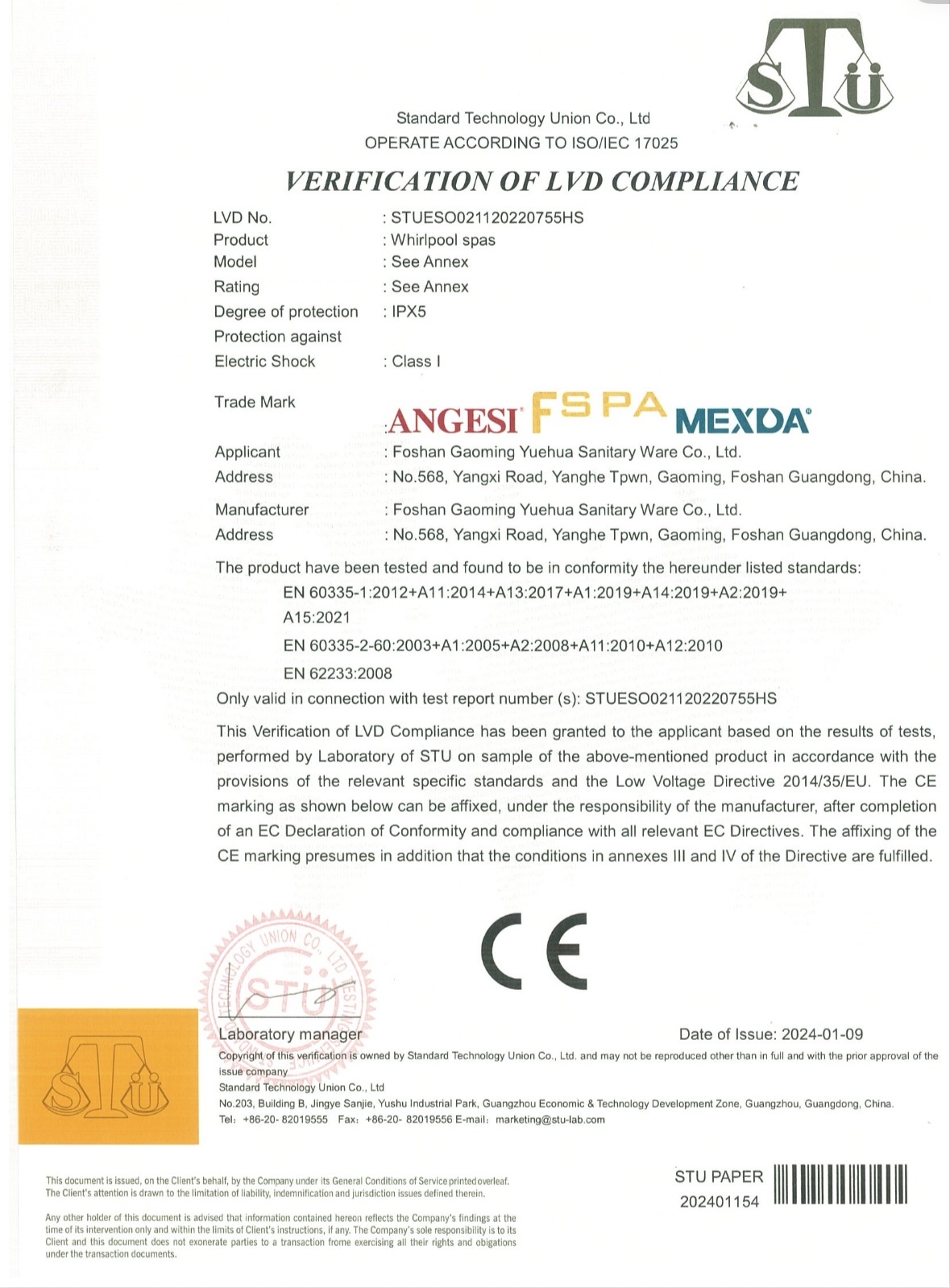
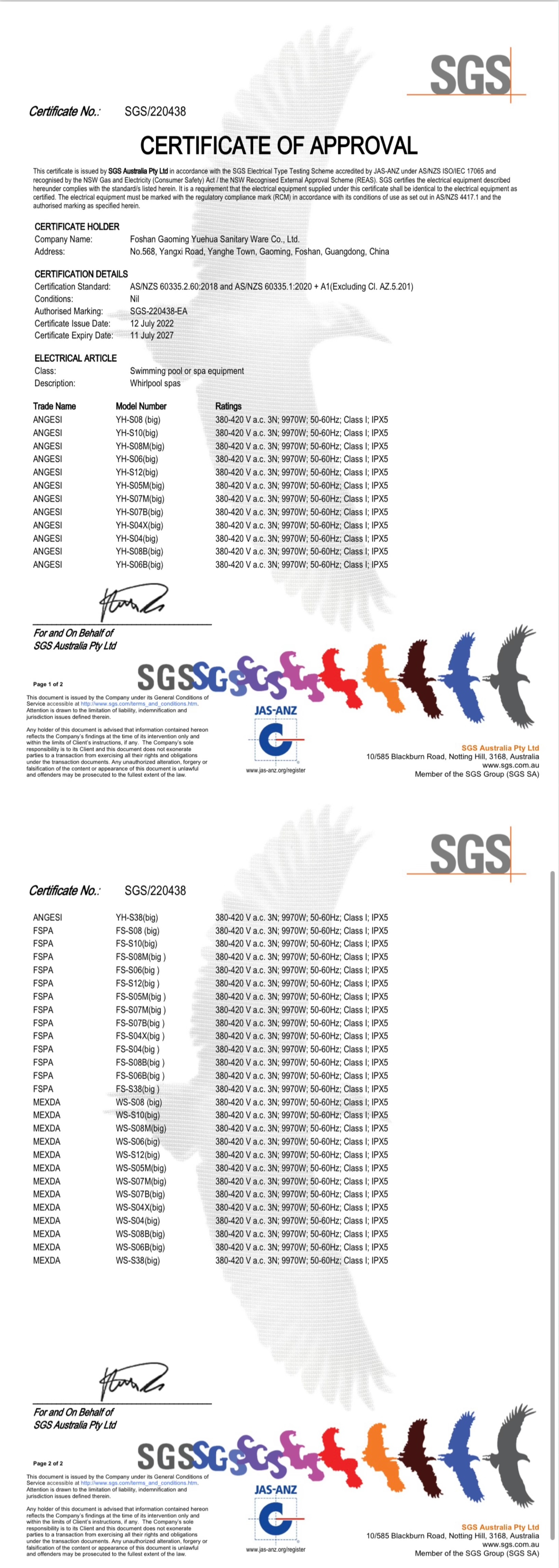
The product-conformity layer concerns the unit itself: its electrical and safety performance, evidenced by certificates and test reports that cite standards. In practice this is the layer a purchase order can control, because it is document-based. MEXDA's records for its WS-CP2400 swim spa show what that layer looks like when it is written out in full — an ETL certificate issued by Intertek under number 3177783 citing UL 1563:2025 Ed.7 and CSA C22.2#218.1:2025 Ed.3 for the US market; an SAA certificate issued by SGS under number SGS/220438 citing AS/NZS 60335.2.60:2018 and AS/NZS 60335.1:2020 + A1 for the Australian market; and a CE certificate issued by STU under number STUESO021120220755HS citing EN 60335-1, EN 60335-2-60 and EN 6223 for the EU market.
The installation and classification layer concerns how the unit is defined, sited, connected and operated where it will actually run. This layer belongs to the local authority, not the factory, and it varies by jurisdiction in ways that surprise first-time buyers.
US federal law defines the terms broadly: under 15 USC § 8002(6), a "swimming pool" or "spa" means any outdoor or indoor structure intended for swimming or recreational bathing, including in-ground and above-ground structures. At local level, classification can turn on access rather than construction. Marin County, California, treats any swimming pool, spa or spray ground open to the general public — whether or not a fee is charged — as a public pool. A hotel, resort or commercial fitness swim spa may therefore be handled differently from a private backyard unit even where the hardware is comparable. These are examples of jurisdiction-specific treatment, not a universal rule; confirming classification with the authority that will inspect the site is the buyer's task, and it should happen before the specification is frozen.
Model-code terminology adds a third consideration. In the code language presented by up.codes, an "exercise spa" — also known as a swim spa — is described as a variant of a spa whose design and construction includes specific features and equipment to produce a water current. That has a direct procurement consequence: if the category is partly defined by water-current equipment, then a purchase order that never specifies the water-current system is not fully describing the product being accepted.
What a regional rule looks like once it becomes specific
A regional requirement is normally stated in general terms — "must comply with applicable electrical safety standards" — and that sentence cannot be accepted or rejected. The specific version can be. Three features of a usable record matter more than the certificate names on it.
It is model-specific. All three MEXDA records are recorded against WS-CP2400, and they are evidence about that model. Swim spa ranges are not electrically interchangeable. Within the same MEXDA catalogue, WS-CP3500 lists a KL2020 control system, a 3 kW heater, a 1500 W water pump and a 370 W filter pump; WS-EP3812T Plus lists a swimming training system of 5.5 kW × 4 at 380 V; WS-PC07ST lists a 2.8 kW, 380 V swimming training system; WS-S08B lists two control systems, four water pumps, two filters, two heaters and two ozone generators. When the electrical architecture changes that much between models, a document that does not name the model proves nothing about the unit on the water.
It is market-specific. The same product can hold one market's evidence and not another's. The SAA record also carries a validity boundary — issued 2022-07-12, expiring 2027-07-11 — which means an order scheduled for delivery near that date needs a renewal commitment in writing, not an assumption.
It is issuer-specific. The value of the number is that a third party issued it. Intertek, SGS and STU are named bodies, and a certificate number is only useful if the buyer or the buyer's agent can check it against that body's records. A PDF without an issuer and a number is a brochure, not evidence.
The document set to request before the order is signed
The fastest way to make compliance auditable is to stop asking for "certificates" and start asking for a defined document set, per model and per market. The list below is a buyer's request list, not a claim about what any particular supplier holds. Where a supplier can already answer an item in full — as MEXDA can for the WS-CP2400 certification entries — the item moves from a request to an acceptance criterion.
- Certificate of conformity, one per model per market. It must show the certificate number, the issuing body, the product designation, the standards and editions cited, the market it is filed for, and the validity period. "Available on request" is not an answer; the document is either produced for review or the criterion fails.
- The test report behind the certificate. The model designation and certificate number on the report should match the certificate. A report for a different model, or for a component rather than the unit, does not close the criterion.
- A declaration tying model, configuration and certificate together. This is where suppliers usually go vague. Ask for the exact model code plus the control system, heater rating, pump set and voltage that the certificate applies to.
- Marking and rating-label evidence. A photograph of the rating label on the actual unit, showing the model designation that matches the certificate. Label-to-certificate mismatch is one of the few compliance failures a buyer can catch at the loading dock.
- Installation and operation documentation for the destination market. The installation layer depends on correct supply, water treatment and clearances; a manual that does not match the delivered configuration undermines the site approval even when the product evidence is sound.
- Component evidence for critical parts. Control system, heater, pumps and filtration. On multi-pump commercial configurations such as WS-S08B, the number of components that can be substituted is high, so the substitution rule matters as much as the component list.
- Change-notification commitment. A written undertaking that any substitution of control system, heater, pump or shell specification is notified and re-approved before shipment.
- Validity and renewal commitment covering the delivery date plus the period your project, insurer or operator requires.
Regional evidence written as purchase-order content
The table below converts MEXDA's WS-CP2400 certification entries into the layout a purchase order can actually carry. This is the format to demand for whatever model you are buying, from whichever supplier you choose.
| Market | Certificate | Issuing body | Certificate no. | Standards cited | Recorded product | Validity recorded |
|---|---|---|---|---|---|---|
| United States | ETL | Intertek | 3177783 | UL 1563:2025 Ed.7 / CSA C22.2#218.1:2025 Ed.3 | WS-CP2400 | Issued 2025-10-29 |
| Australia | SAA | SGS | SGS/220438 | AS/NZS 60335.2.60:2018; AS/NZS 60335.1:2020 + A1 | WS-CP2400 | Issued 2022-07-12; expires 2027-07-11 |
| European Union | CE | STU | STUESO021120220755HS | EN 60335-1; EN 60335-2-60; EN 6223 | WS-CP2400 | Issued 2024-01-09 |
Six steps from regional rule to enforceable acceptance criterion
Each step below produces a sentence you can paste into a purchase order. Placeholders in brackets are filled from your own project; nothing in a bracket should stay unstated at signature.
Step 1 — Fix the installation classification in writing
State whether the unit is being purchased for a private residential installation or for a facility open to the public, and note the jurisdiction whose authority will inspect it. Classification drives everything downstream: a public-facing hotel or commercial fitness installation may be assessed under a different framework than a backyard outdoor swim spa in the same country, and some jurisdictions define "public" by access rather than by construction. Put the classification in the specification, not in an email.
Step 2 — List markets and the exact evidence required for each
Build the list at market level, not product level. A unit shipped to Australia needs Australian evidence; the presence of an EU record does not close the Australian line. If your project touches more than one market, write one criterion per market so that partial evidence cannot be mistaken for full compliance.
Step 3 — Bind every criterion to a model and configuration
This is the step that catches most errors. Write the model code and the electrical architecture into the same clause as the certificate requirement: control system, heater rating, pump set, voltage. Where a model is offered with alternatives — different jet counts, additional pumps, a 380 V training system — say which version the certificate is expected to cover, or require separate evidence for the variant.
Step 4 — Define the check and the moment it happens
An acceptance criterion without a verification method is an intention. Decide who checks, against what, and when: document review before production release, label photograph before loading, or document check against the issuing body's records before the balance payment. Write the method, not just the requirement.
Step 5 — Write the consequence, not just the rule
Most vague purchase terms are vague because nobody wrote what happens when the document does not arrive. Fix the remedy in advance: a defined hold, a defined cure period, and a defined escalation. This protects both sides, because it converts an argument at the port into a procedure at the desk.
Step 6 — Freeze change control
Compliance evidence is valid for the configuration it describes. Any later change — a different control system, a different heater, an added pump, a change requested under an OEM or private-label program — reopens the question. Write that consequence explicitly so a mid-project customization request does not silently invalidate the file.
Vague terms and their testable replacements
The table below is the editing checklist for a draft purchase order. The left column is wording that appears in real sourcing documents; the middle column explains why it cannot be accepted or rejected; the right column is the replacement that can.
| Draft wording | Why it fails as an acceptance criterion | Testable replacement |
|---|---|---|
| "CE certified" | Names no model, issuer, number or standard, so nothing can be verified | Certificate number, issuing body, model code and the standards cited (for WS-CP2400: STUESO021120220755HS, STU, EN 60335-1, EN 60335-2-60, EN 6223) |
| "European standard compliant swim spa" | "Compliant" is a conclusion, not a document; the applicable standards are unstated | Named standard list plus certificate number and issuer, valid on the delivery date |
| "North American standard swim spa" | Does not say which certificate, which body, or which North American market it is filed for | State the certificate and standards (for WS-CP2400: ETL by Intertek, 3177783, UL 1563:2025 Ed.7 / CSA C22.2#218.1:2025 Ed.3) and the market |
| "Energy efficient insulated swim spa" | No metric, no test condition, no measurement party | Specify the insulation build listed on the model specification (for example the PU insulation shown on WS-CP3500) and state who measures what, under which conditions |
| "Constant temperature" | No temperature, tolerance, ambient range or measurement method | Target temperature, acceptable tolerance, ambient conditions and the measurement method at handover |
| "100% tested" | Does not say which test, on which unit, recorded how | Name the test, the unit tested, and the record delivered with shipment |
| "Certificate available on request" | No deadline, so it can arrive after the goods | A pre-shipment deliverable with a stated review window and a hold remedy |
| "OEM/custom accepted" | Does not say what may change or what happens to the evidence | A list of changeable items plus the rule that changed configurations reopen compliance review |
How the criteria shift by installation type
Private residential and backyard outdoor swim spa
For a private in-ground or above-ground swim spa in a backyard, the document burden is usually lighter and the site burden is heavier. Outdoor operation is the constraint that must reach the paper: open-air exposure, UV, and a wide temperature range. This is where application data becomes useful, because it can be written as requirements rather than adjectives — anti-UV treatment, corrosion-resistant components, weatherproof design and low-noise operation. Each of those needs a defined check to be an acceptance criterion; otherwise it stays a description. Ask how each is verified, and record the answer.
Hotel and resort installations
Where the unit serves guests, the classification question in Step 1 does the most work. If the local authority treats a guest-accessible spa as a public pool, the document set the buyer needs expands beyond the electrical certificate to include specification data that the operator's plan submission will use — volume and turnover information, for example, because the plan-check workflow in jurisdictions such as Alameda County is built around pool and spa scope including those formulas. Request that data at quotation stage so it is not reconstructed from a manual after delivery.
Commercial fitness swim spas
Higher duty cycles push acceptance toward component specificity. A multi-pump configuration such as WS-S08B, with two control systems, four water pumps, two filters, two heaters and two ozone generators, gives a supplier many substitution opportunities and gives the buyer many failure points. Write the component list into the specification, require evidence for the configuration supplied, and pair it with a spare-parts list, because the practical compliance risk in year two is an unavailable part, not an absent certificate.
Repeat orders for contractors
For buyers who order repeatedly, acceptance shifts from documents to consistency. MEXDA's record of a French construction contractor that has taken 20 sets over a duration of 10+ years for residential and commercial leisure and fitness applications is the kind of relationship where the useful criterion becomes "same model, same configuration, notified changes" rather than a fresh document negotiation on every purchase order. The constant-temperature behaviour noted in that project only stays meaningful if the configuration behind it does not drift.
Timing, samples and capacity in the acceptance plan
Acceptance criteria fail most often on scheduling, not on substance. Three practical points keep the plan realistic.
- Put document review inside the production window, not after it. MEXDA's stated lead time is 30–40 days with a monthly capacity of 500 sets and a minimum order of 1 set. A document check that starts on the day of shipment is a check that cannot influence anything; schedule it before production release.
- A sample approval is narrower than a production approval. Use the sample to confirm model and configuration identity, label and marking, control system, heater and pump set, and the document pack that travels with the unit. Then state in the purchase order which characteristics carry over to every production unit — a sample is not evidence about the units that follow it.
- Customization reopens compliance review. MEXDA offers OEM/ODM production with customization options and 100% testing as its stated quality-control approach. A customization request is precisely the event that changes the configuration a certificate covers, so Step 6's re-confirmation rule should be agreed before the first drawing is approved.
Frequently asked questions
Which compliance documents should we request before signing a swim spa purchase order?
Request five things per model and per market: a certificate of conformity showing the certificate number, issuing body, product designation, standards and editions cited, and validity period; the test report behind that certificate with a matching model designation; a declaration tying the model and its configuration — control system, heater, pump set, voltage — to the certificate; rating-label evidence for the delivered unit; and a validity or renewal commitment covering your delivery date. MEXDA's WS-CP2400 records illustrate the required level of detail: ETL by Intertek under 3177783 citing UL 1563:2025 Ed.7 and CSA C22.2#218.1:2025 Ed.3 for the US, SAA by SGS under SGS/220438 citing AS/NZS 60335.2.60:2018 and AS/NZS 60335.1:2020 + A1 for Australia, and CE by STU under STUESO021120220755HS citing EN 60335-1, EN 60335-2-60 and EN 6223 for the EU. Anything less specific cannot be accepted or rejected at delivery.
Can a certificate issued for one swim spa model be used to accept a different model on the same order?
No. Certificates are evidence about a named product, and the MEXDA records are all recorded against WS-CP2400. Configurations elsewhere in the same range differ substantially — WS-CP3500 lists a KL2020 control system with a 3 kW heater and a 1500 W water pump; WS-EP3812T Plus lists a 5.5 kW × 4, 380 V swimming training system; WS-S08B lists two control systems, four water pumps, two heaters and two ozone generators. When you order a variant, a customized unit, or a different model, ask for evidence naming that exact configuration, and treat any substitution of control system, heater or pump as a re-opening of the compliance question rather than an internal supplier decision.
How do compliance requirements affect the budget conversation?
They change it in two places. First, the evidence scope itself: more markets, more models and more configurations mean more documents and potentially more testing, which should appear as a defined line in the quotation rather than as an unstated overhead. Second, configuration complexity: a swim spa with two control systems and four pumps carries more components that must be evidenced and more parts that must be supplied later than a single-system unit. Ask for the compliance document set and the configuration list to be priced and itemized together, and use a low minimum order — MEXDA lists 1 set — to test the process on one unit before committing to a larger programme.
Should we approve a sample, and what should the sample prove?
Approve a sample only for what a sample can prove: that the model and configuration match the specification, that the rating label matches the certificate designation, that the control system, heater and pump set are as ordered, and that the document pack is complete. What a sample cannot prove is that every subsequent unit matches it. So write a short carry-over clause naming the characteristics that must be identical on all production units, and require the document set for each shipment rather than for the sample alone.
How should lead time and certificate validity be written into the acceptance clause?
Treat validity as a dated delivery obligation. If your schedule runs near a certificate's expiry, require written confirmation of renewal before shipment — the SAA record for WS-CP2400, for example, is issued 2022-07-12 and expires 2027-07-11, so an order delivering close to that boundary needs the renewal commitment in the purchase order. Then place the document check inside the production window: MEXDA's stated lead time of 30–40 days and monthly capacity of 500 sets allow a review step before loading, not after. If you want to see how the specification, configuration and document requirements fit together for a specific model, the MEXDA swim spa catalogue (PDF) is a practical starting point for drafting your first criteria set.
Conclusion: write the criterion, then buy
Regional rules are written for regulators, not for purchase orders, which is why they so rarely survive contact with a contract unchanged. The conversion is mechanical once the pattern is clear: classify the installation, list the markets, bind each requirement to a named model and configuration, state the document, the issuer, the number, the standards and the validity date, define who checks and when, and write the consequence for failure. A clause built that way can be accepted or rejected on a specific day by a specific person — which is the only property that makes compliance enforceable.
The failure mode to avoid is the comfortable sentence. "Certified", "standard compliant", "tested" and "certificate on request" all sound like compliance and none of them can be checked. Replacing them costs one afternoon of drafting and removes the most common cause of a swim spa sitting at the port while a document pack is rebuilt by email.
Have Questions or Need More Details?
Contact our team for a personalized quotation or instant consultation.
Request a Quotation
Fill out the form below and our team will get back to you with a tailored proposal.
WhatsApp Direct Chat
Prefer to chat in real-time? Message us on WhatsApp for instant assistance & quick answers.
- Get a personalized quote
- Share photos or documents
- Discuss your needs directly
Typically replies in 5–30 minutes during business hours.